
Wine Culture (English)
Burgundy’s Climats: Why Every Vineyard Plot Has a Name (and How It Pairs with Vietnamese Food)
Th10
In most wine regions, people ask who made the wine. In Burgundy, the more revealing question is where – down to the exact hillside plot. This small strip of eastern France has spent nearly a thousand years mapping its vineyards field by field, and in 2015 UNESCO recognised that patient work as World Heritage. Here, from our table in Hanoi, is the story of Burgundy’s climats – and how a Burgundian Pinot Noir finds its place at a Vietnamese meal. 🍷
The Golden Slope
Burgundy (Bourgogne in French) runs from Chablis in the north down through the Mâconnais in the south. Its heart is the Côte d’Or, a narrow, mostly east- and southeast-facing limestone escarpment stretching south from Dijon. It splits into two halves:
- Côte de Nuits in the north, home to celebrated Pinot Noir villages such as Gevrey-Chambertin, Chambolle-Musigny and Vosne-Romanée.
- Côte de Beaune in the south, famous for both reds and great Chardonnay from Meursault, Puligny-Montrachet and Corton-Charlemagne.
Two grapes do almost all the work: Pinot Noir for red, Chardonnay for white. What changes from bottle to bottle is the ground beneath the vines.
Monks, Walls and a Ducal Decree
Much of Burgundy’s vineyard knowledge was built by the Church. The Benedictines of Cluny (founded 910) and the Cistercians of Cîteaux (founded 1098) owned and tended vineyards across the region for centuries. Generation after generation, they noted which plots ripened earlier, which escaped frost and which gave deeper, longer-lived wine. Some of the finest parcels were enclosed by dry-stone walls – a clos. The Cistercians’ Clos de Vougeot remains the region’s most famous example.
Secular rulers shaped the vineyard too. In 1395, Duke Philip the Bold banned the Gamay grape from Burgundy’s better sites in favour of Pinot Noir, a decision that still defines the region’s red wine more than six centuries later.
What Is a Climat?
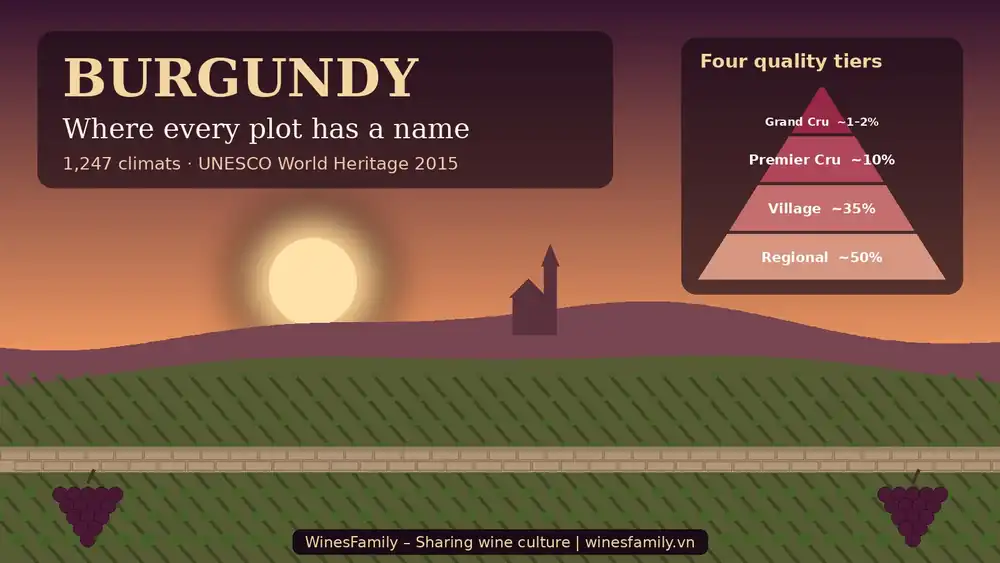
In everyday French, climat means climate. In Burgundy, it means a precisely delimited, named vineyard plot with its own soil, slope and exposure – and its own recognisable character in the glass. In July 2015, “The Climats, terroirs of Burgundy” – 1,247 named plots along the Côte de Nuits and Côte de Beaune, together with the historic centre of Dijon and the town of Beaune – were inscribed on the UNESCO World Heritage List.
History then made things beautifully complicated. After the French Revolution, Church vineyards were seized and sold, and Napoleonic inheritance law divided estates equally among heirs. Today a single famous vineyard like Clos de Vougeot is shared among many owners, some farming only a few rows. Same vineyard name, different hands – which is why Burgundy rewards curiosity more than almost any other region.
Reading a Burgundy Label: Four Tiers
Burgundy’s appellation system ranks the land, not the producer. From broadest to most specific:
- Regional (e.g. “Bourgogne”): grapes may come from across the region; roughly half of all production.
- Village: named after a single commune, such as Gevrey-Chambertin or Meursault.
- Premier Cru: village name plus a named climat and “Premier Cru” or “1er Cru”; around 10% of production.
- Grand Cru: the summit, labelled with the vineyard name alone (Chambertin, Musigny, Montrachet); only about 1–2% of production across Burgundy’s 33 Grands Crus.
A handy rule of thumb: the more precise the place name on a Burgundy label, the higher the tier is likely to be.
November in Beaune
The Hospices de Beaune, a charitable hospital founded in 1443 by Nicolas Rolin, chancellor to the Duke of Burgundy, was gifted vineyards over the centuries. Since 1859, their wines have been sold at an annual charity auction. The 166th edition takes place on Sunday 15 November 2026, keeping the tradition of the third Sunday in November and turning Beaune into a weekend-long celebration (source: Beaune Tourist Office).
A Burgundy Pinot at a Vietnamese Table
Red Burgundy’s light-to-medium body, bright acidity and gentle tannins make it one of the friendliest reds for Vietnamese cooking, which balances sweet, salty, sour and herbal flavours rather than relying on heavy sauces. A few pairings we love:
- Vịt quay – Vietnamese roast duck with a five-spice glaze. Pinot Noir and duck are a classic match anywhere, and the wine’s red-cherry fruit lifts the spice.
- Bún chả – Hanoi’s chargrilled pork patties and pork belly served with rice noodles, fresh herbs and a sweet-sour fish-sauce dip. The wine’s acidity cuts through the smoky fat without overpowering the herbs.
- Bò lá lốt – minced beef grilled in wild betel leaves. Pinot’s earthy, forest-floor notes echo the peppery, aromatic leaf.
Serving tip for warm climates like ours: red Burgundy shows best at about 14–16°C, so give the bottle 15–20 minutes in the fridge before opening, and use a wide-bowled Burgundy glass to let the aromas open up.
Glossary
- Climat: a named, precisely bounded vineyard plot in Burgundy with its own natural conditions.
- Clos: a vineyard enclosed by stone walls.
- Terroir: the combined influence of soil, climate, topography and human tradition on a wine’s character.
Burgundy’s lesson is a simple one: great wine begins with respect for a place. Next time you raise a glass of Pinot Noir, picture the small hillside where those grapes grew. 🍇
Please enjoy responsibly. Never drink and drive. Intended for adults of legal drinking age.
WinesFamily – Sharing wine culture | winesfamily.vn